Purple Mountain Observatory led Team Finds Evidence for a Hidden Reservoir of Hot Gas Around the Sombrero Galaxy
Recently, a research team from the Purple Mountain Observatory, Chinese Academy of Sciences, in collaboration with the University of Michigan, Tsinghua University, and the University of Massachusetts Amherst, combined deep X ray observations from the European Space Agency’s (ESA) XMM Newton satellite and microwave measurements of the Sunyaev-Zel’dovich (SZ) effect from another ESA mission, Planck. The team has uncovered a long overlooked, massive reservoir of hot gas surrounding the Sombrero Galaxy. The findings indicate that the hot galactic halo of the Sombrero Galaxy is far more extensive and energetic than what is directly revealed by X ray observations. The study, entitled A Possible Hidden Hot Halo Component Revealed by Joint X ray and Sunyaev-Zel’dovich Observations, was published in The Astrophysical Journal in September, 2026.
Galaxies are not isolated collections of stars. They are surrounded by enormous halos of gas extending far beyond their visible disks. This circumgalactic medium acts as a reservoir of matter, metals, and energy, and plays a central role in regulating how galaxies grow and evolve. Hot halo gas is commonly studied through X-ray emission. But X-rays preferentially reveal the densest gas, because the brightness rises rapidly with density. A large amount of more diffuse gas could therefore remain almost invisible. The Sunyaev-Zel’dovich effect offers a different view. As photons from the cosmic microwave background pass through hot ionized gas, they gain energy through interactions with energetic electrons. The resulting subtle distortion in the microwave background depends on the total electron pressure along the line of sight, making it sensitive to diffuse gas that may emit very little X-ray radiation.
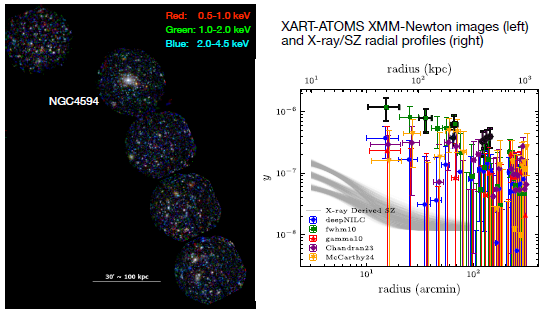
Fig. 1 Left: Tri-color X-ray image of NGC 4594 (the Sombrero galaxy) obtained with XMM-Newton. North is up and East is to the left. Right: Radial profiles of the SZ signal around NGC 4594. The coloured symbols show measurements from different microwave maps, while the grey curves show the SZ signal predicted from the X-ray-emitting hot gas. The observed microwave signal exceeding the X-ray prediction provides key evidence for a substantial reservoir of hot, diffuse gas that is difficult to detect directly in X-rays. See the published paper for details.
The team used deep XMM-Newton observations from the X-raying the Accretion Reservoir Transferred to the ATmosphere Orbiting a Massive Spiral program, or XART-ATOMS, an AO-21 Large Program with a total observing time of 460,000 seconds, to measure the density and temperature of the X-ray-emitting halo around the Sombrero galaxy. They then calculated how strong the corresponding Sunyaev–Zel’dovich signal should be and compared it with measurements from five independent Planck-based microwave maps, some of which also combined data from NASA’s Wilkinson Microwave Anisotropy Probe, or WMAP. The observed microwave signal most likely exceeds the value predicted from the X-ray-emitting gas, particularly at a distance of about 50,000 parsecs, or roughly 160,000 light-years, from the galaxy center. This suggests that a large fraction of the Sombrero Galaxy’s hot circumgalactic medium may exist in an extremely diffuse and very hot state, making it difficult to detect directly with conventional X-ray observations. Under a simple two-component model, the most probable X-ray-to-SZ ratio implies that the gas visible in soft X-rays may occupy less than one percent of the halo volume near this radius. The rest of the volume could be filled by a much hotter and more diffuse component. Because this gas would have a lower density, it could carry substantial pressure and thermal energy while remaining extremely faint in X-rays. If this interpretation is correct, conventional single-phase X-ray analyses may underestimate the total mass of hot gas by a factor of about 2.5 and the total thermal energy by roughly an order of magnitude.
This result may help address two long-standing puzzles in galaxy evolution: the apparent shortage of ordinary matter around galaxies compared with the amount predicted by cosmology, known as the “missing baryons” problem, and the difficulty of accounting for the large amount of feedback energy released by stars and supermassive black holes, known as the “missing galactic feedback” problem.
If this hot, low-density gas component does indeed exist, it must be unusual. To avoid detection in the existing X-ray spectra, it may need to be extremely hot, spatially extended, or much less efficient at producing X-rays than the detected gas. Such temperatures would be far above the characteristic virial temperature expected for the Sombrero galaxy’s dark matter halo. This raises an important question: how could the gas be heated and confined? One possibility is that the gas is part of a more extended, group-scale atmosphere. Another is that past activity from the galaxy’s central supermassive black hole injected energy into the halo. The discovery of radio lobes near the center of the Sombrero galaxy provides evidence that its nucleus has been active in the past. The team also considered whether an extended population of aged cosmic-ray electrons associated with fossil radio lobes could contribute to the microwave signal.
This study demonstrates the potential of combining X-ray and Sunyaev-Zel’dovich (SZ) observations to investigate the hot gaseous halos of galaxies, and may offer a new avenue for searching for missing baryons and missing feedback energy around galaxies.
It demonstrates how combining X-ray and Sunyaev-Zel’dovich observations can reveal components of galactic coronae that neither technique can fully characterize alone. X-ray observations show where the gas is dense and bright. Microwave measurements probe the integrated pressure along the line of sight, including contributions from gas too diffuse to shine strongly in X-rays. A mismatch between the two can therefore expose hidden phases of matter and energy.
Future microwave observations with higher angular resolution and improved sensitivity, together with next-generation high-resolution X-ray spectroscopic observations, will help determine whether the excess pressure originates from extremely hot gas, relativistic particles, or discrepancies between current X-ray and microwave measurements.
This study was led by Research Professor Jiang-Tao Li from the Purple Mountain Observatory, Chinese Academy of Sciences. The collaborative team includes researchers from the University of Michigan, Tsinghua University, and the University of Massachusetts Amherst. This work was supported by the National Natural Science Foundation of China, China Manned Space Engineering, and the Jiangsu Innovation and Entrepreneurship Talent Team Program, among other projects.