A Neutron Star’s Missing “Birth Certificate” Comes to Light
A pulsar caught in the tidal tail of the 8-billion-year-old open cluster NGC 6791 provides the first direct evidence of a neutron star transit from its parent cluster into the dispersed stellar population of the Milky Way.
In 1934, Walter Baade and Fritz Zwicky proposed that supernova explosions could create neutron stars from normal stars. A decade later, Baade introduced the concept of stellar populations, showing that the Milky Way is made up of distinct groups of stars. Yet a link between these two ideas remained missing: how does a neutron star born in a star cluster eventually become one of the thousands scattered across the Galactic disk?
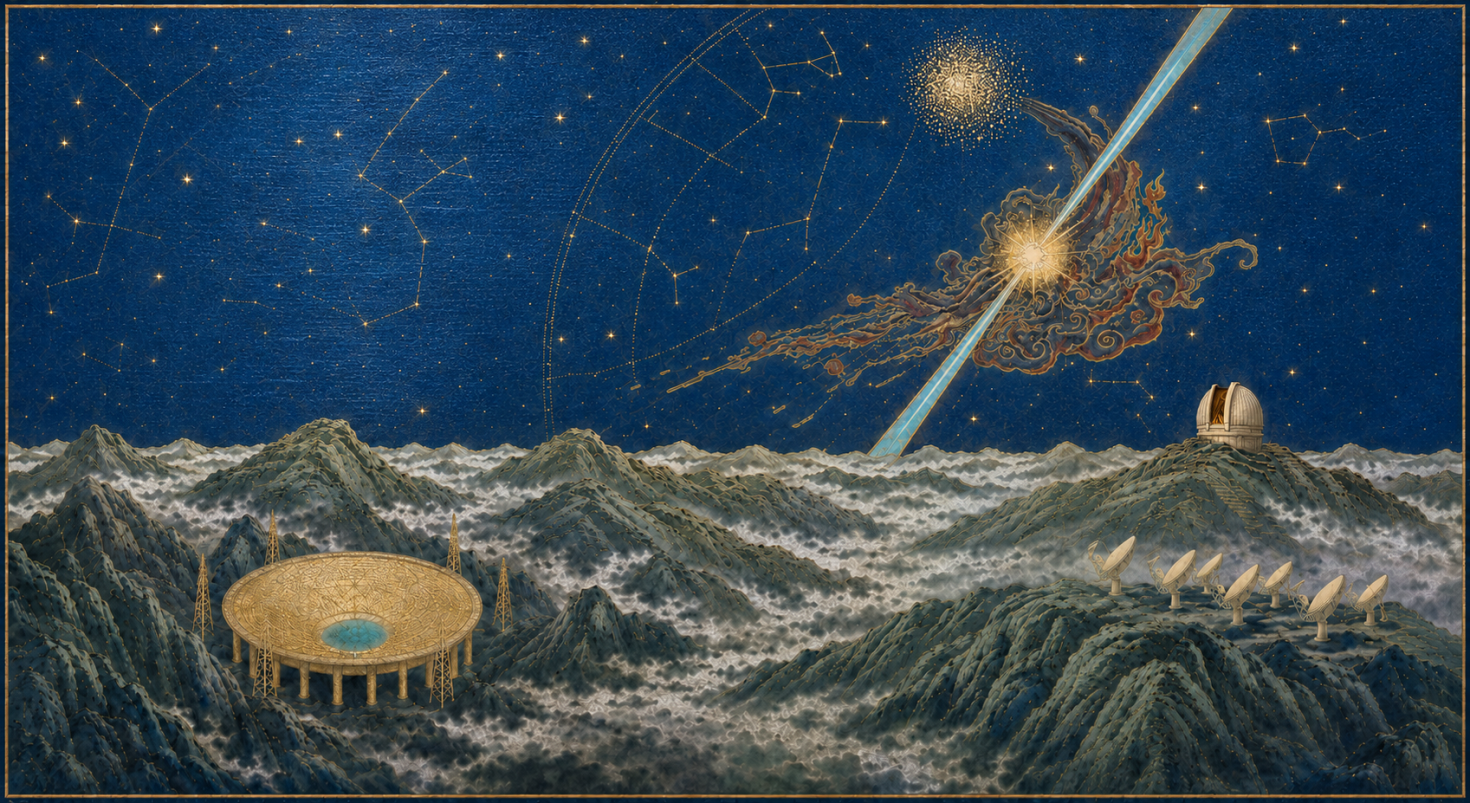
Fig.1 Artist’s impression of the pulsar PSR J1921+3745 within the tidal tail of the ancient open cluster NGC 6791. Three telescopes serve the work: FAST detected the pulsar, MeerKAT pinpointed its position, CFHT mapped the surrounding stellar structure.
An international research team has now found a neutron star apparently caught during this transition. The team targeted NGC 6791, one of the oldest and most massive open clusters known in the Milky Way.
The pulsar’s “birth certificate” was assembled through a global scientific relay that connected telescopes in the physical world with experiments in a simulated one. China’s Five-hundred-meter Aperture Spherical radio Telescope (FAST) detected the 1.9-second isolated pulsar PSR J1921+3745; the MeerKAT radio telescope in South Africa determined its position with arcsecond-scale precision; and deep observations from the Canada-France-Hawaii Telescope mapped the surrounding stars. Direct N-body simulations then reconstructed the evolutionary path that could have brought the neutron star to its present location.
The work is published as the inside cover on Science Bulletin on August 30, 2026. The study is led by Xiaoting Fu of Purple Mountain Observatory and Di Li of Tsinghua University, both in China. The collaboration brought together scientists based at institutions in Australia, Canada, China, Germany, Italy, South Africa, and the United States, making the result itself a product of international coordination across continents and disciplines.
The combined observations place PSR J1921+3745 within a prominent tidal tail of NGC 6791—a stream of stars gradually being stripped from the cluster by the Milky Way’s gravity. Its estimated distance, the low probability of a chance alignment and the absence of a nearby young stellar population all support a physical association with the star cluster.
Telescopes tell us where the pulsar is today, simulations explain the missing evolutionary history. In a N-body simulation tailored to NGC 6791, more than 95% of neutron stars are rapidly expelled by powerful supernova kicks. A neutron star formed through a relatively gentle electron-capture supernova with small kick velocity, however, could remain bound for billions of years before stellar encounters and Galactic tides gradually carried them into the cluster’s tidal tails. This provides a natural explanation for the location of the pulsar PSR J1921+3745.
This discovery provides the first direct observational evidence of a neutron star in the tidal tail of an open cluster, revealing a previously missing stage between a neutron star’s birth in a stellar group and its later life in the Galactic field. It also opens a new avenue at the intersection of stellar evolution, supernova explosion, pulsar astronomy, star-cluster dynamics and the structure of the Milky Way.
Nearly a century after Baade connected supernovae, neutron stars and stellar populations, one pulsar in a tidal tail has finally provided a traceable route from a neutron star’s birth cluster to its future in the wider Milky Way.