First Submillimeter Lights Reveal How Massive Stars Reshape Their Birth Clouds
A team led by researchers from Purple Mountain Observatory, the Chinese Academy of Sciences, has achieved the first successful submillimeter astronomical observations from Dome A, Antarctica, the highest and driest site on Earth. Using the Antarctic Terahertz Explorer with a 60 cm aperture (ATE60), the team detected emission from carbon monoxide (CO) and neutral atomic carbon (C0) in prototypical triggered massive star-forming regions, offering new insight into how massive stars shape their surrounding environments. The results, published in Science Advances, represent the first peer-reviewed report of submillimeter spectral observations from Dome A, long considered one of the most promising yet challenging sites for submillimeter and terahertz astronomy.
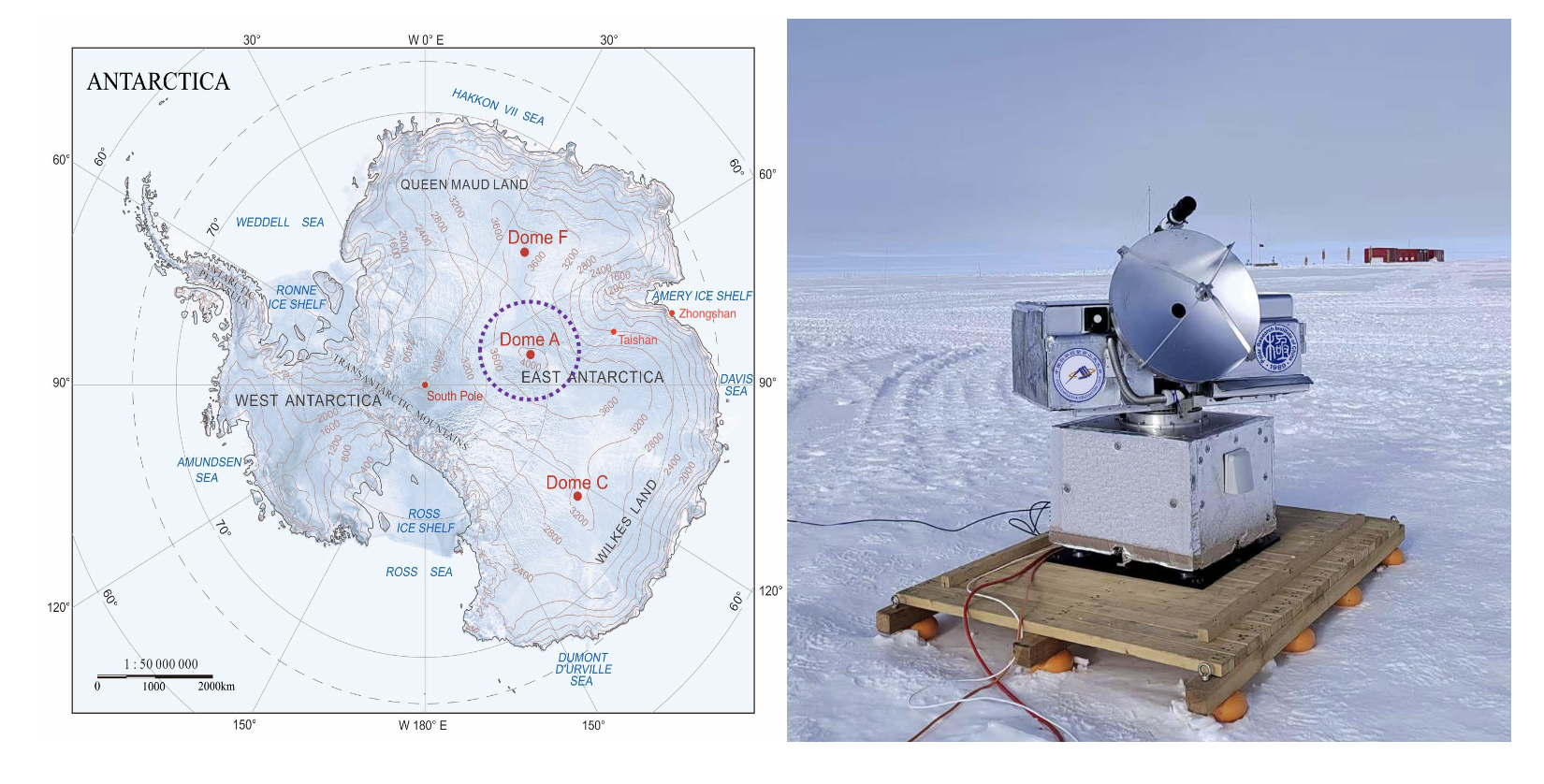
Fig. 1. Map of Antarctica with elevation contour lines, including an inset showing a photo of ATE60 deployed at Dome A in January 2025 during the 41st CHINARE. The red building discernible in the distant background is the Chinese Kunlun Station. (Image by GONG Yan et al)
Located at an altitude of more than 4,000 meters on the Antarctic plateau, Dome A offers exceptionally low atmospheric water vapor—conditions ideal for observing submillimeter and terahertz radiation that is largely inaccessible from most ground-based observatories (see Fig. 1). Using ATE60, the team successfully observed the CO (4–3) and [CI] (³P₁→³P₀) emission lines toward two massive star-forming regions RCW 79 and RCW 120.
Carbon exists in multiple forms in interstellar space—ionized, atomic, and molecular—each tracing different physical conditions. By simultaneously detecting CO and neutral atomic carbon emission, and combining these measurements with archival C⁺data, the team was able to probe how intense ultraviolet radiation from massive stars reshapes their surrounding molecular clouds (see Fig. 2). The observations indicate that neutral carbon is not confined to cloud surfaces but extends deep into molecular regions, highlighting the importance of stellar feedback in regulating cloud chemistry and evolution. These observations demonstrate for the first time that Dome A is capable of high-quality submillimeter astronomy, paving the way for routine observations at the site.
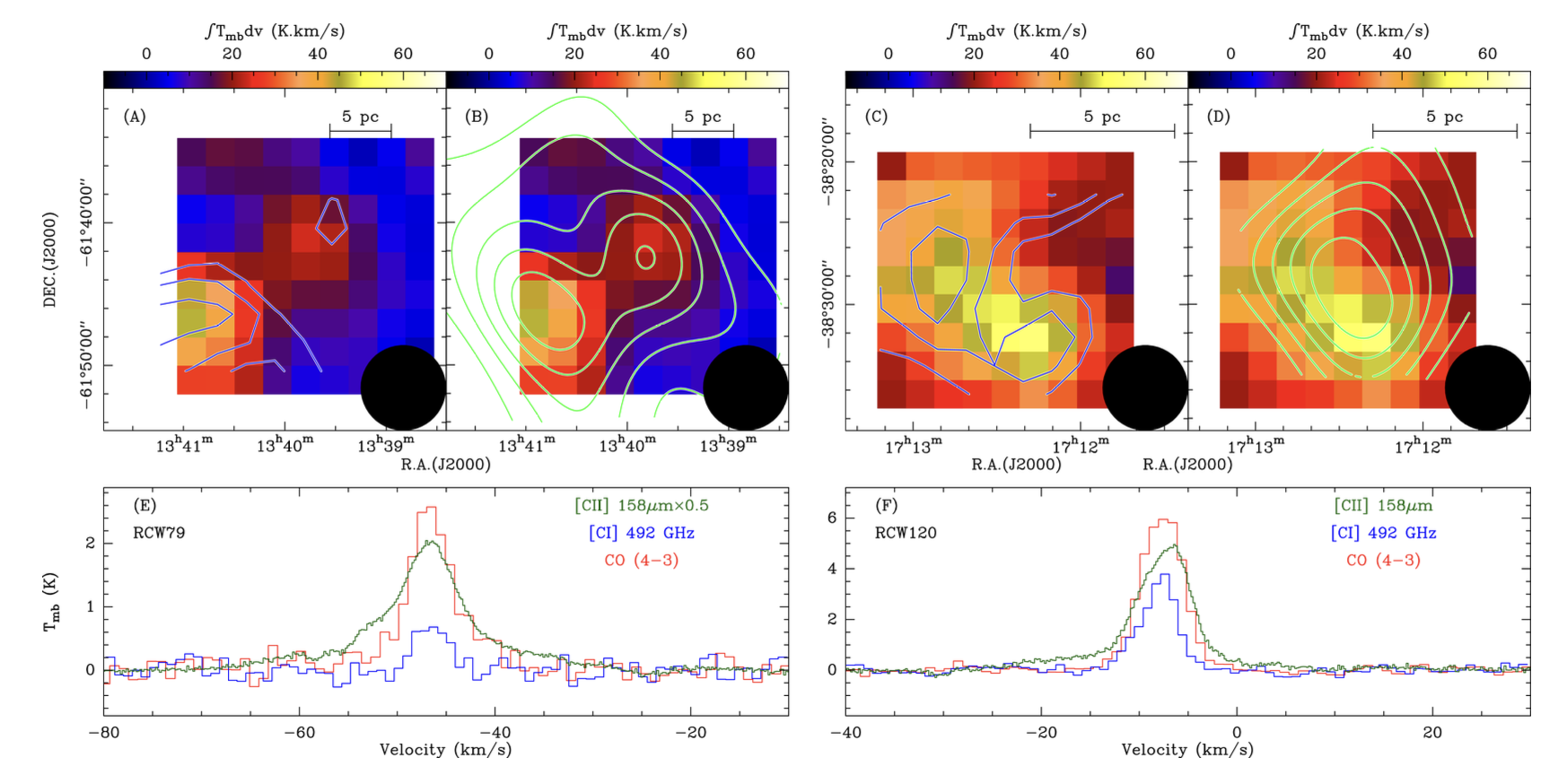
Fig. 2. Distribution and spectra of C+, C0, and CO in RCW 79 and RCW 120. (Image by GONG Yan et al)
This achievement represents an advance for Antarctic astronomy and validates decades of site-testing efforts. The success of ATE60 paves the way for larger submillimeter and terahertz facilities at Dome A, opening new opportunities to study the interstellar medium, star formation, and the early Universe. These first results show that Antarctica can emerge as one of the world’s premier sites for submillimeter and terahertz astronomy.