Dark Matter Particle Explorer (DAMPE) Observes the Charge-Dependent Limit of Cosmic Ray Acceleration
Date:30-04-2026 Print
The international collaboration of the Dark Matter Particle Explorer (DAMPE) satellite, for the first time, directly observes charge-dependent spectral softenings of five primary cosmic-ray nuclei, i.e. protons, helium, carbon, oxygen, and iron. This observation confirms the charge-dependent acceleration model first proposed in the 1960s, offering a key clue toward solving the longstanding mystery of Galactic cosmic-ray origin.
Cosmic rays (CRs) are energetic particles traveling through space at speeds close to that of light. They consist of atomic nuclei, electrons and positrons, high-energy gamma rays, and neutrinos, and are thought to originate from extreme astrophysical objects such as supernova remnants, rapidly rotating neutron stars, and accreting black holes. Although cosmic-ray research has spanned more than a century, fundamental questions—how and where they are produced, how they are accelerated, and how they propagate and interact in interstellar space—remain unresolved. The energy spectrum of CRs, which reflects how particle numbers vary with energy, encodes rich physical information. Precise measurements of the spectra of individual CR components are essential for understanding those fundamental questions of cosmic ray physics.
The Dark Matter Particle Explorer (DAMPE), also known as “Wukong”, is China’s first space astronomy satellite which was designed to study high-energy cosmic rays and indirectly probe dark matter. Since launched at late 2025, DAMPE has been operated flawlessly for over a decade, accumulating 18.5 billion high-energy particle events. DAMPE has an excellent energy resolution, a very good particle identification capability, and a reasonably large acceptance, making it well suitable for the studies of precise spectral structures of cosmic rays, particularly in the tera- to peta-electronvolt range.
Analyzing nine years of on-orbit data, the DAMPE collaboration precisely measured the spectra of the five most abundant cosmic-ray nuclei. For the first time, distinct spectral softenings were directly detected in the spectra of carbon, oxygen, and iron nuclei, by extending the measurements to peta-electronvolt energy range. Combined with the updated proton and helium spectra, the spectral softening appears universally at a rigidity of about 15 teravolts (Figure 1). A nuclei-mass-dependent softening is rejected at a confidence level of >99.999% (Figure 2).
Combined with large-scale anisotropy measurements, the results indicate a nearby cosmic-ray accelerator, with the universal spectral softening marking its charge-dependent energy limit (Figure 3). The DAMPE observation provides the first direct experimental verification for a 1961 hypothesis “Peters cycle”, which posited that particle acceleration in magnetic field should obey a charge-dependent limit. With the continuous operation and data collection of DAMPE, it is expected to shed new light on the fundamental questions about cosmic ray physics.
This research work by DAMPE collaboration has been published in Nature on 29 April, 2026.
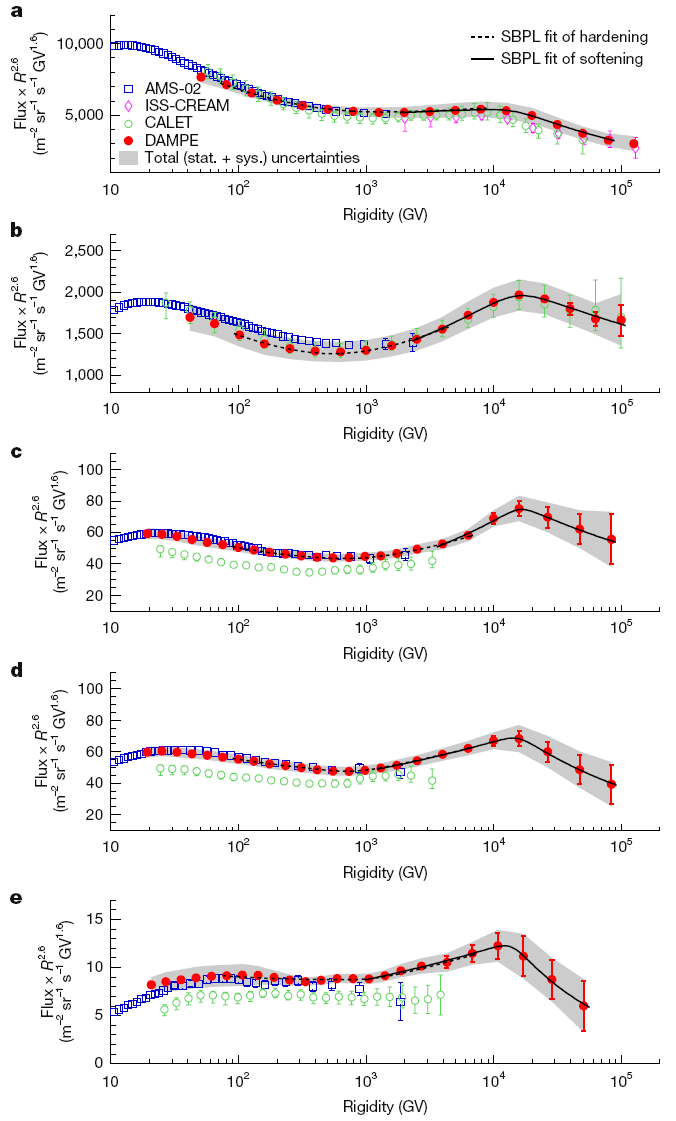
Figure 1. a–e, The spectra of protons, helium, carbon, oxygen and iron, weighted by R2.6. The DAMPE measurements are shown as red dots, which clearly illustrate the universal softening at a rigidity of about 15 teravolts. (Image by DAMPE collaboration)
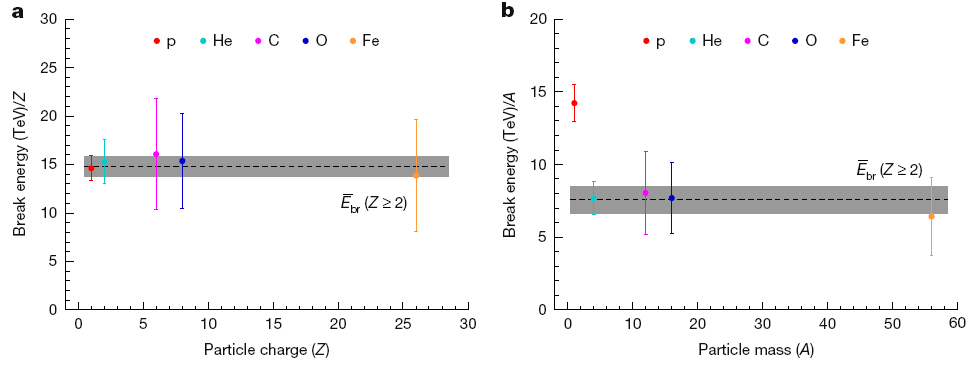
Figure 2. The break energies for different species divided by particle charge Z (left) and particle mass A (right). (Image by DAMPE collaboration)
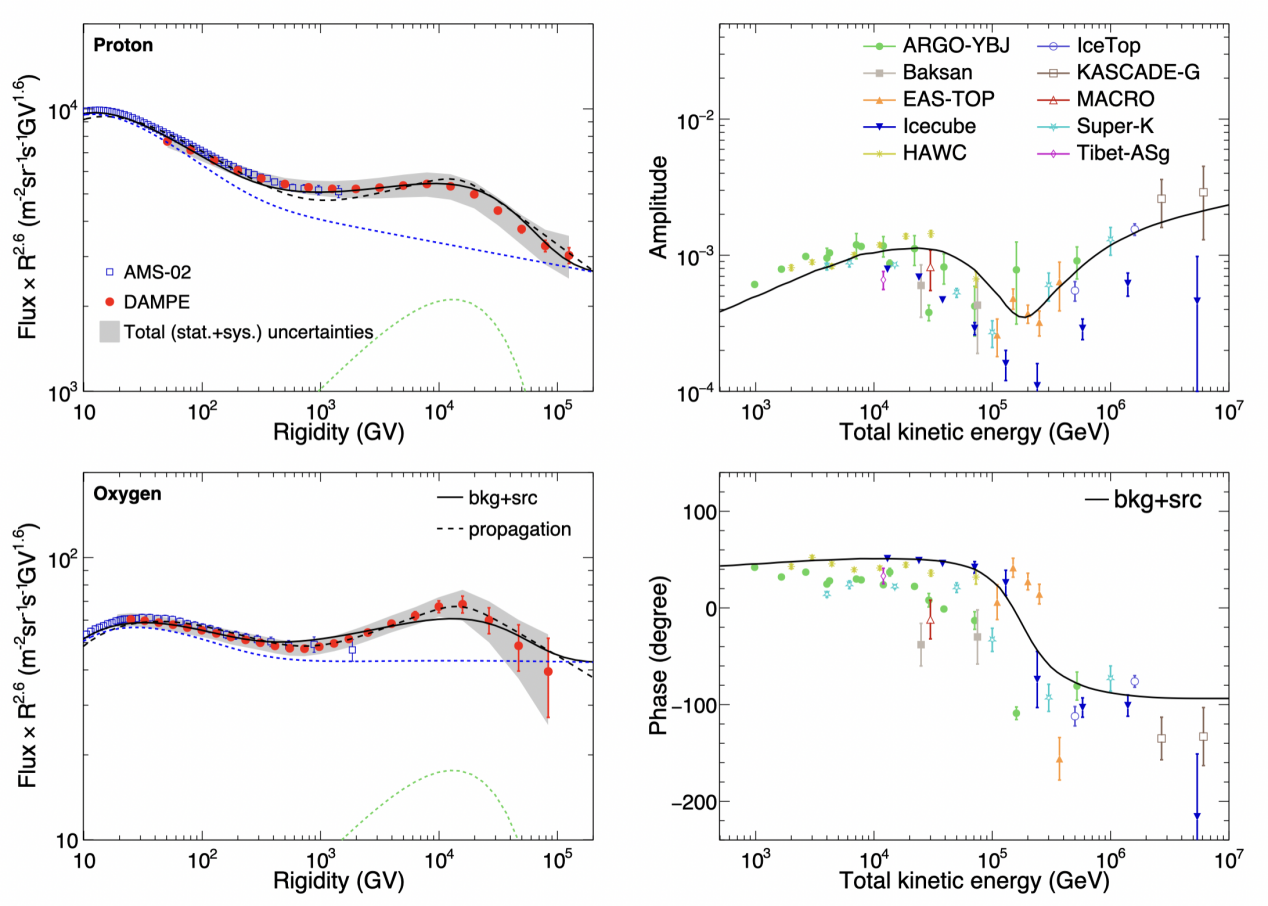
Figure 3. The nearby source model (solid line) to simultanesouly explain the spectral softenings (left) and the amplitudes and phases of the dipole anisotropies (right). (Image by DAMPE collaboration)